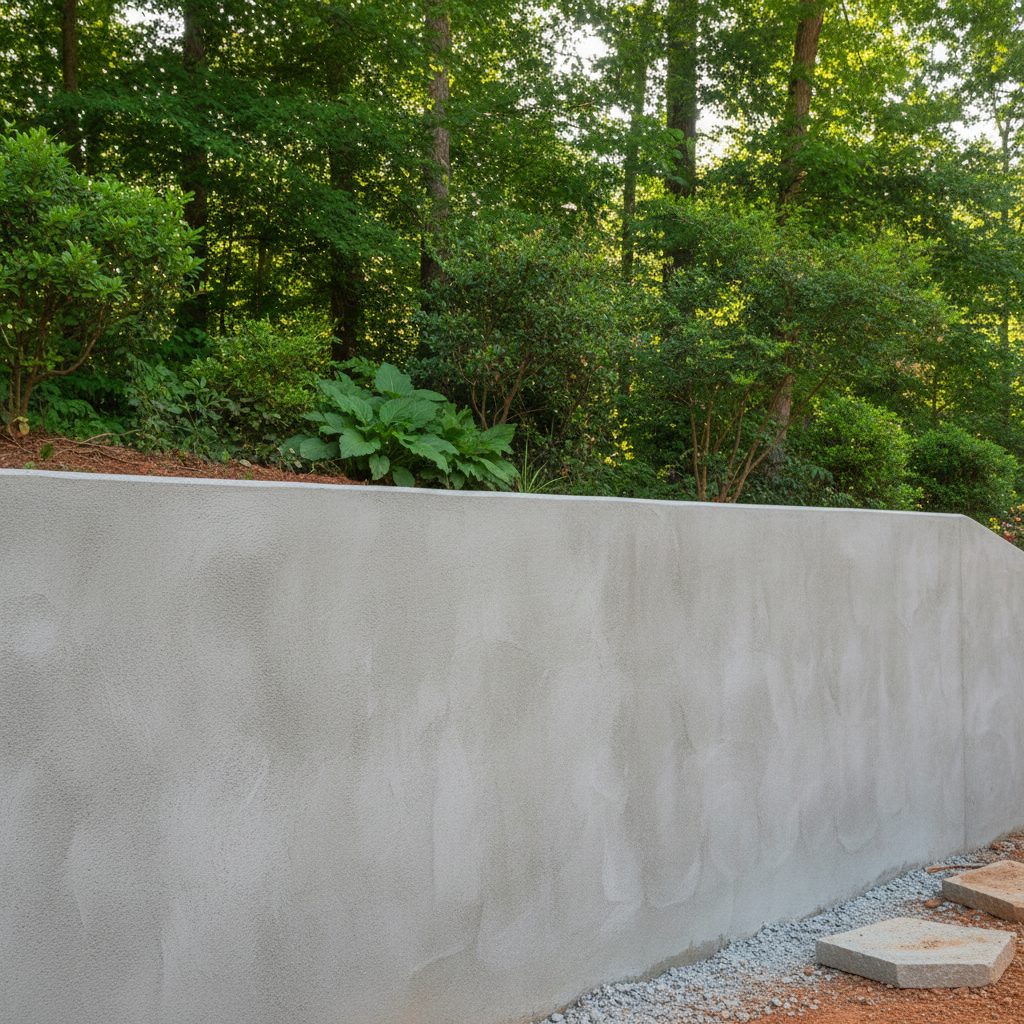
Alright, let's talk retaining walls. If you've got a sloped yard here in Athens, especially around some of those older Five Points or Normaltown homes with their tight lots, you've probably thought about putting one in. Maybe you've got erosion issues, or you just want to make a usable, flat space out of a hillside. Concrete retaining walls are a solid choice, no pun intended, but folks always have a ton of questions. I'm gonna hit the most common ones I hear.
Why do I even need a retaining wall? Can't I just landscape around the slope?
Look, you can try to landscape around a slope, but there's a limit to what plants and terracing can do, especially if it's a significant grade. The main reasons for a retaining wall are pretty straightforward: they stop soil erosion, create level ground for patios, driveways, or gardens, and help manage water runoff. Here in Athens, with our red clay and occasional heavy downpours, erosion is a real problem. That red dirt washes away fast, taking your topsoil and plants with it, and sometimes even undermining foundations if it gets bad enough. A properly built concrete retaining wall holds that soil back, keeps your property where it belongs, and gives you a stable, flat area you can actually use. It's about function first, then making it look nice.
What's the difference between a concrete block wall and a poured concrete wall?
That's a big one. When people say 'concrete retaining wall,' they're usually thinking of one of two things: either a wall built from pre-cast concrete blocks, or a wall poured in place with ready-mix concrete. Concrete block walls, often called segmental retaining walls (SRWs), are pretty common. They're built from interlocking blocks, usually without mortar, relying on their weight and internal reinforcement (like geogrid) for stability. They're good for smaller walls, and they can look nice with different textures and colors. But they have limits on height and how much pressure they can hold back.
Poured concrete walls, on the other hand, are exactly what they sound like. We build forms, pour liquid concrete into them, and let it cure. These walls are monolithic – meaning they're one solid piece. They're incredibly strong, can handle much greater heights and pressures, and we often reinforce them with rebar for even more strength. For anything over four feet, or if you've got a serious load behind it, a poured concrete wall is usually the way to go. They're also more versatile in terms of design; you can stamp them, stain them, or give them different finishes. Kingdom Concrete Athens specializes in these long-lasting poured walls because we believe in building things that stand the test of time.
How tall can a concrete retaining wall be? Do I need a permit?
This isn't a one-size-fits-all answer, but generally, if your retaining wall is going to be over four feet tall (measured from the bottom of the footing to the top of the wall), you're almost certainly going to need an engineered design and a building permit from Athens-Clarke County. Even for walls under four feet, if they're supporting a significant load, like a driveway or a structure, you might still need engineering. It's not just about the height you see; it's also about the depth of the footing and the slope of the land. Don't skip the permit process. It's there for your safety and to make sure the wall is built to code. Trying to cut corners here will cost you way more in the long run if the wall fails or if you try to sell your house later, believe me.
What about drainage? Is that important for a retaining wall?
Crucial. Absolutely critical. I can't stress this enough. Water is the biggest enemy of any retaining wall. If you don't have proper drainage behind the wall, water will build up, create hydrostatic pressure, and eventually, that pressure will push your wall over. It's not a matter of 'if,' but 'when.' Every good retaining wall needs a drainage system. That typically means a layer of gravel directly behind the wall, a perforated drain pipe (often called a French drain) at the base of the gravel, and weep holes through the wall itself to let that water escape. The drain pipe should be sloped to carry water away from the wall and out to a safe discharge point. Without it, you're building a dam, not a retaining wall, and dams eventually break.
How long does a concrete retaining wall last?
A properly designed and installed poured concrete retaining wall, with good drainage and reinforcement, can easily last 50 to 100 years, or even more. We're talking generations. That's one of the big advantages of concrete. It's incredibly durable and resistant to rot, insects, and fire. Block walls might have a slightly shorter lifespan, depending on the materials and installation, but they're still very long-lasting. The key is 'properly designed and installed.' If corners are cut on the footing, reinforcement, or drainage, then all bets are off. That's why choosing an experienced contractor like Kingdom Concrete Athens matters. We build these walls to last, because nobody wants to rebuild a retaining wall every 10-20 years.
What's the typical cost for a concrete retaining wall in Athens, GA?
This is probably the most common question, and it's also the hardest to give a simple answer to because there are so many variables. The cost depends on the height and length of the wall, whether it's poured concrete or block, the amount of excavation needed, the type of soil (some soils need more extensive footings), how accessible the site is, the amount of reinforcement, drainage requirements, and any special finishes. For a basic poured concrete wall, you're generally looking at anywhere from $50 to $150 per square foot of wall face, sometimes more for complex projects or difficult access. That includes excavation, materials, rebar, forms, concrete, and labor. It's a significant investment, no doubt, but it's an investment in the stability and usability of your property. The best way to get an accurate estimate is to have us come out, take a look at your specific situation, and discuss your needs. We can then give you a detailed quote tailored to your project.
Do concrete retaining walls require much maintenance?
One of the best things about concrete retaining walls is how little maintenance they need once they're properly built. Unlike timber walls that can rot or shift, concrete is pretty hands-off. You'll want to keep an eye on the drainage outlets to make sure they're clear of debris – leaves, dirt, whatever might block them. If you notice any cracks, especially large or spreading ones, or if you see the wall starting to lean, that's a sign to call us immediately. Small hairline cracks are often normal as concrete cures and settles, but anything significant needs to be checked out. Other than that, maybe a power wash every few years to keep it looking clean, especially if you're in a high-traffic area or have a lot of pollen. It's a 'set it and forget it' kind of solution, which is why so many folks choose it.